

Find an installer
Compare quotes from verified solar installers near you
Enter your PIN code & get matched on the next page.
Installers manually verified by a human
As of now, the carbon tax price (INR/ton) under India's compliance market remains undefined, making it premature to determine the most cost-effective strategy for your businesses. This price will be the key factor in shaping your next course of action. Until the tax rate is announced, any agency or consultant offering you carbon market solutions is primarily after your money 💸—because, without a defined price signal, there is no way to optimize decisions.
Once the carbon tax is set, you will have three strategic options:
1️⃣ Abatement – Investing yourself in cleaner technologies to reduce emissions.
2️⃣ Buying permits – If available within the market framework.
3️⃣ Purchasing carbon credits – If allowed and economically viable.
Contact us at [email protected] to understand your options under a carbon market regime.
What wont happen is unlike the EU ETS, which follows a fixed-quantity cap-and-trade model, India has not adopted an explicit emissions cap, adding further uncertainty to the system. Until clarity emerges, the best approach is to stay informed and assess all options based on actual regulatory developments. 📊🚀
You need a end buyer
You will be one these 3 entities to participate in the carbon market. depending on the status of your factory emissions. (See the figure below.... )
There are many options for marriage between buyer and sellers in a carbon market , but the most preferred chice is bilateral developer and a end buyer. A bi lateral developer could be yourself or a clean tech developer where the end buyer could be anybody from government , corportations , donors or individuals. As an example UK host of COP26 was as buyer of voluntaty credits through bilateral agreement.
The least preserred choice is crypto , consumer level add on purchases like carbon neutral purchases , futures exahenges ,
You have the following to mull about in estimating the size of carbon market business in India. India has signed the least no of bi lateral agreements with potential acquiring countries so dont expect the market to explore. As a host country for ITMO ( a type of bi lateral agreeement for carbon market ) India has crediting mechanisam with only Japan. Why this is possiby is perhaps becasue India is home to many Japanese manufacturing companies
Apart from the buyers , sellers , there will be a ecosystem mostly cornered by western firms : brokers , brokers of buyers ( with whom you will rarely interact )
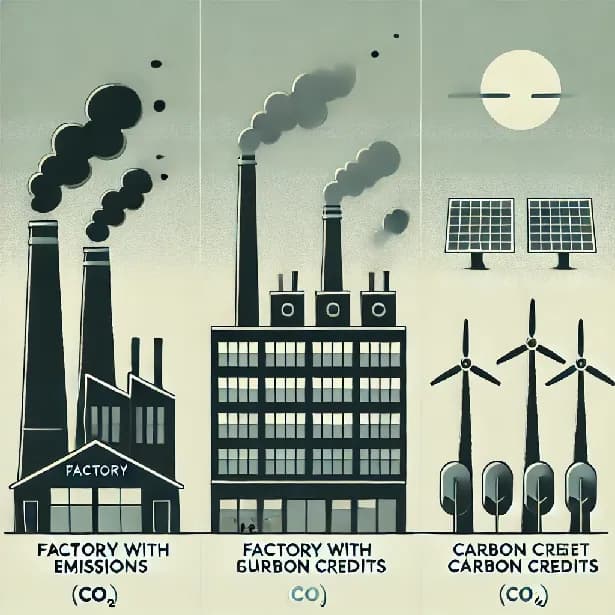
They key challanges right now are
- You dont know how much carbon you need to purchase ? Since baseline is not clear or accurate for your sector and I cannt find my govt studies on baselining.
- You dont know where to buy from ? We dont know what all markets are allowed in carbon offserts ( e.g. renewables/ clean cooking) and to what percent
- You dont know the price of carbon ? If price is too low it wont suceed , too high is bad for economy)
- You dont know price projected ( no studies done for economic analysis for carbon in India )
Hence you are not doing anything which is fair as this is the time when we keep our hands warms by keeping them in the pocket which incidently also conserves cash. My oun experience has been that Carbon market planning and design has been outsourced to foreign consultants , keeping the expertise of Indian consultancies like TERI out.
**Carbon Price for India : Speculation
**
As of early 2025, carbon pricing varies significantly across major markets. Below is an updated chart illustrating the carbon prices (in USD per metric ton of CO₂) in key markets, arranged from low to high
Carbon price in India is anybodys guess , but I would expect it to be near China National ETS at USD 10 / t CO2, beacuse we like to follow what is China is doing.
Estimated Carbon Price (USD per ton)
|
10 | █████████████████████
|
0 +---------------------------
Indian Carbon Market
| GLobal Carbon Market
| Carbon Price (USD/tCO₂) | | --- | --- | | Poland's Carbon Tax | $0.10 | | Japan's Carbon Tax | $2.36 | | Spain's Carbon Tax | $16.13 | | China's National ETS | $10 | | California Cap-and-Trade | $46 | | Quebec's Cap-and-Trade | $46 | | United Kingdom's Carbon Price | $50 | | European Union ETS | $76 | | Norway's Carbon Tax | $107.78 | | Sweden's Carbon Tax | $127.26 |
**Marginal Abatement cost ( MAC) for your company will help you make your decision
**
💨 Is a unique technology option which comes at a certain price INR / ton and can reduce a certain quantity of CO2. It can range from options costing $ 1 per ton of CO2 abated for technologies like washing Coal to $ 100 per ton of CO2 abated like for Green Hygrogen and CCUS
Options are uaually arranged from the least to the most expensive, providing a clear visualization of the most cost-effective strategies for reducing emissions.
For instance, the MACC might include options such as improving energy efficiency, transitioning to renewable energy sources, or implementing carbon capture and storage technologies. Each of these options would be represented by a bar, with its position and size reflecting its cost-effectiveness and abatement potential.
Marginal Abatement Cost Curve for Indian Stationary Power (CO2) will involve several technologies ranging from the simple and cheap ( costing less to more expensive)
Price (INR/ton)
1500 | 💨
1400 |
1300 |
1200 | 💨
1100 |
1000 |
900 |
800 | 💨
700 |
600 |
500 | 💨
400 |
300 | 💨
200 |
100 |💨
0 |_________________________________________
0 100 200 300 400 500
Abatement (MtCO₂/yr)
**Expect compliance market $ 10 per ton (increase 5% each year) equivalent ~INR 900 / ton ( increase 5% per year)
**
Compliance market or Carbon Tax will be applicable to mandatory sectors and there is no escaping for them where the government wants regulation ( perhaps because they are high emitters)
However compliance markets globally have not suceeded very much and are still short of hopes. In India they are expected to succeed even less as we have not yet planned them well.
The top 2 compliance markets are EU and China and these markets even have given negative price signals in Feb 2025 for delays
The complaiance sectors in India who shoud be keen thinking how to reduce their GHG emissions and must already have a stategy in place.
- Aluminium
- Chlor-alkali processes
- Cement
- Fertiliser
- Iron and steel
- Pulp and paper
- Petrochemicals
- Petroleum refining
- Textiles
Voluntary market
- e.g.Gold standard, ETS ( Korea, Mexico, California, EU, China ) , CORSIA ( aviation fuel ) , Kyoto Protocol , CDM , JI. There are other markets w
- No FIXED price unlike Complaince market above
- No mandatory participation required
- Supports your initiatives will additional econimic revenue/ rent under "green" activities. e.g. you were a Aluminium producer and were leaking the high GHG gases in the atmosphere and wanted to invest $1mn in a state of control process cntrol where you will now be able to invest 50% of your own investment and 50% from a volntary market