

Find an installer
Compare quotes from verified solar installers near you
Enter your PIN code & get matched on the next page.
Installers manually verified by a human
Peak power pricing avoidance through demand response
Any commercial and industrial consumer will be planing to reduce peak tariff. Which is usually for 1-2 hours in the mornning and the evening when consumers can pay as high as INR 10-INR 12 per unit and risk load shedding. There are many strategies which consumers were exploring in the past , like installation of solar / wind , which has now evolved in complex contracts where consumers will ask DISCOM or RE developer to give a fixed RE power ( e.g 500MW) at a price of INR 4.5-IN R5.5 per unit , guaranteed for every hour of the day. There are also consumers who are installing BESS for peak hours tariff avoidance.
Demand response , often overlooked area is an option with least investment where you can save INR 1 / unit for 4 hours per day
A 50-100 MW Demend Reponse program, with each event lasting 2 hours as "event-based" Demand Response (Curtailable load management) and 3 hours event in "time-based" (Critical Peak Pricing) Demand Response for selective days in a year is targeting LT and HT consumers, could potentially generate total saving of ~Crores for consumer and DISCOM in a span of 3 years, assuming incentive of INR 1.00/kWh is provided to the participating consumers under both the types of DR programs.
Consumer participation is necessary in demand response program by DISCOM
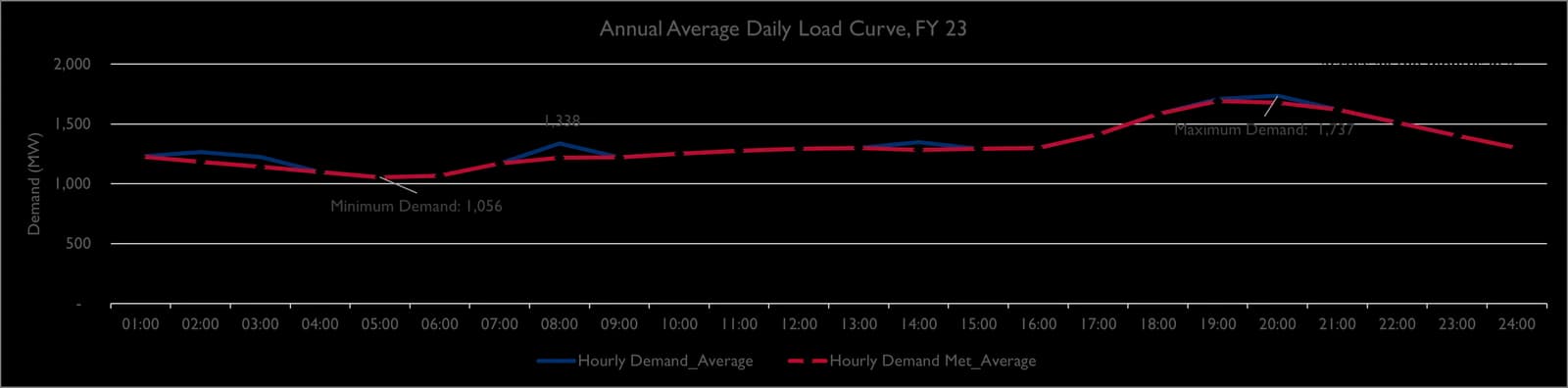
Load profile at a typical DISCOM which showd during peak hours (1700 hours to 2200), demand met is lower than actual supply of energy
The graph above shows Quantum of short-term power purchase increases during peak period of a day (1700 Hours to 2200 Hours), when power is expensive at market. Daily load profile of DISCOM varies upto 64% with peak demand 1.7 times the minimum demand , this leads to high unplanned tariff leading to expensive electricity tariff to the consumer. Hence consumer and DISCOM must work together for demand response and share the benifits. In addition , Load shedding observed during few hours of the day only (0200 – 0300 hours, 0700-0800 hours, 1300-1400 hours and 1800-2000 hours) which is another reason to co benifit.
**DISCOM has several challanges which need your ( commercial and industrial consumer ) participation and sharing co benifits.
**
- Demand is Recorded higher in Monsoon season (July to October)
- > 50% of the annual short-term power is purchased during monsoon season.
- Load shedding instances highest during April to October (>145 hours).
- Load shedding observed during few hours of the day only (0200 – 0300 hours, 0700-0800 hours, 1300-1400 hours and 1800-2000 hours).
- Duration of load shedding in FY23: ~1,658 hours (19% of the year), maximum quantum: 600 MW
DISCOM faces Deviation Settlement losses
- Deviation of w.r.t. schedule was higher from FY19 to FY22 resulting in penalty on commercial consumer for~INR 40 Crore every year. for some DISCOMs
- Deviation handled well during FY23 resulting into incentives received by consumer (~4.71 Crores in one case we supported).
**Pilots we can support you for demand response
**
- DISCOM side
- Consumer Side side
Perspectives for load management | Prerequisites to implement the load management | Types of Load control / Demand management | ||||
Incentive based | Price based | |||||
Direct Load Control (Auto DR) | Indirect Load Control (Manual DR) | Critical Peak pricing (CPP) | Real Time Pricing | Time of Day/ Time of Use Tariff | ||
Utility | Hardware | Tools for load forecasting & Baselining, Demand Response Automation Server (DRAS), Meter Data Management System (MDMS) | Time of Day Tariff Structure | |||
Software | ||||||
Communication technology | Wide Area Network (WAN) | |||||
Load aggregator | Hardware | Meter Data Concentrator Unit | Not applicable | |||
Software | Tools for load forecasting & baselining | |||||
Communication technology | NAN (Neighbourhood)/ MAN (Metropolitan) | |||||
Customer | Hardware | Smart meter with RF Modem/ PLC Modem, Load Controllers,/ Load Control Switchgear, Home monitoring & control consoles & smart appliances | Trivector meter with multiple tariff capability | |||
Software | Energy Management System (HEMS/ BEMS) integrated with DRAS client software | None | ||||
Communication technology | Wi-Fi/ Zigbee based wireless HAN (Home Area Network) or PLC based wired HAN | None | ||||
Pilots to support demand response at Consumer side
Residential | Switch off / shift non- essential load such as microwave ovens, washing machine, dryers, water motors |
Air Conditioning – Increase temperature, smart thermostats & controls to increase temperature remotely | |
Behind the Meter Batteries | |
Smart Appliances & Home Energy Management System | |
Battery Electric Vehicles (BEVs) and Plug-In Hybrid Electric Vehicles (PHEVs) | |
Commercial | HVAC with VFD, shifting AC load on Thermal Storage |
Building Management System | |
Lighting – wireless lighting control system to adjust lighting level or switch off lighting | |
Heat Pump | |
Behind-the-Meter Batteries | |
Staggering of Pumping Operations | |
Industrial | Mandatory DG operation coincide with DR event |
Staggering of Wastewater treatment and pumping operations | |
HVAC with VFD, shifting AC load on Thermal Storage, | |
Onsite Generation (Rooftop Solar) + Energy Storage | |
Industrial Process Optimisation - adjusting production schedules, modifying equipment operations, or temporarily reducing energy-intensive processes |