

Find an installer
Compare quotes from verified solar installers near you
Enter your PIN code & get matched on the next page.
Installers manually verified by a human
🔌 EV Charging Business Models in India
Four types of business models and six types of EV chargers are common across India.
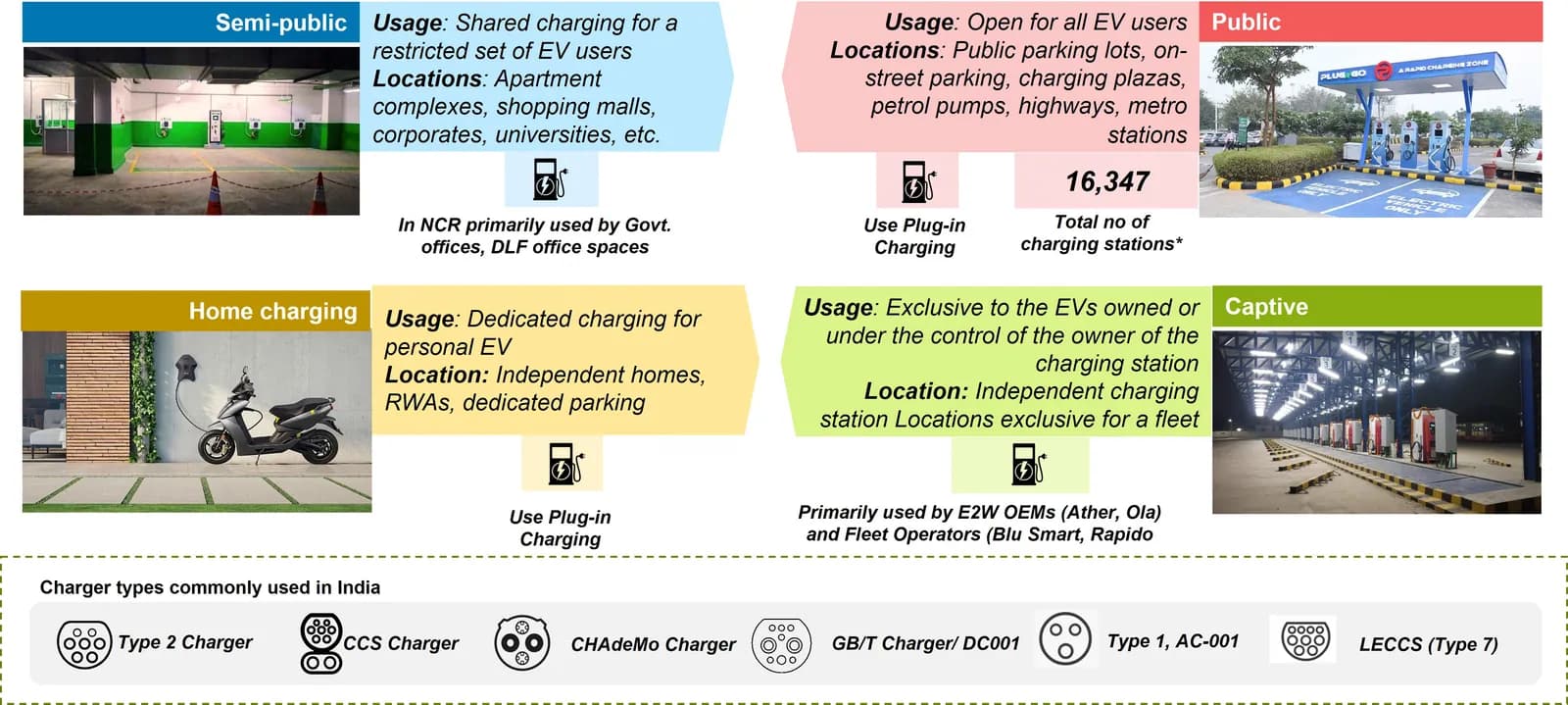
If you're trying to figure out how to enter or expand in the EV charging business in India, you’re weighing the pros and cons of at least three ways to go about it.
Option 1 Distribution or trading of different types of EV chargers by procuring them from manufacturers in India / China ( we are keeping high quality chargers out from this segment) . Your distribution strategy will change depending on adoption rate of EV chargers in various market segments and target customers. What this means is that if you get in tendering route with govt ( EESL CESL ) , it will have larger volumes but responsibility of maintaiance and often a performance require bank guarantee. However the specs of quality will be lower.
Option 2 : Tie up with global OEMs like Tesla or BYD, who will bring advanced chargers (but with more technical requirements like ground/earth monitoring and higher maintenance requirement).
Option 3 : Become a Charge Point operator ( CPO). You want to become a charge point operator then be ready to start competing with the below companies CPO is very competitive with so many
operators alreardy in the fray as you can see the table below
| CPO | Charge Zone |
| CPO | Statiq |
| CPO | Fortum |
| CPO | EESL |
| CPO | Magenta Power |
| CPO | EVI Technologies |
| CPO | MoEVing |
| CPO | Lithion Power |
| CPO | Adani Total Energies |
| CPO | Jio BP |
| CPO | Ather Energy |
| CPO | Bolt |
| CPO | Supriya Charging Infrastructure |
| CPO | One Point Five DC P. Ltd. |
| CPO | VOLTTIC |
| CPO | goEgo |
| CPO | Electric PE |
| CPO | Battery Smart |
| CPO | Sun Mobility |
| CPO | Blu Smart |
| CPO | Blu Smart |
| CPO | Tata Power |
📩 Connect with us at [email protected] to explore selling your EV chargers.
4th option ( not listed above ) is to partner with electric fleet aggregators who are setting up their own charging infra to support captive fleet charging
🔌 🚗 🛺 🚚 ✈️
Electric three wheelers (e3W)- The vehicle to charger ratio is generally 1:2 (1 charger each for 2 vehicles). These are slow chargers and generally take 3-3.5 hrs. to complete a full charge. A 7kw AC charger costs around INR 50,000/ charger. For the captive fleet charging and parking- the Capex cost for 10,000 sq. feet charging hub which can house 80-100 vehicles costs around 50-60 lakhs with 60 EV chargers
For e-buses- the ratio is 1:12 (1 charger each for 12 buses) as fast chargers are used. The cost per charger for a 240kw fast charger ranges between INR 1.6-1.8 Mn
For the e4W fleet operators- The charger to vehicle ratio is just over 1:2 ( 1 charger for 1.6 cars). The cost of a slow charger of 50 kw costs around INR 0.3-0.4 Mn
Public charging is not yet profitable and the major push for installation of chargers is driven by fleet aggregators and e-bus operators. However, all aggregators are factoring in demand increase and building their capacity to also support outside charging requirement
If you are starting as a charge points operator ( see above table for competition )( now you playing catch up to compete in installing public chargers at locations where maximum traffic is expected.
Here is what has already been done and important locations have been taken.
Sl. No. | State | Number of Public EV Chargers |
1 | Andhra Pradesh | 327 |
2 | Bihar | 124 |
3 | Delhi | 1886 |
4 | Karnataka | 5130 |
5 | Manipur | 17 |
6 | Meghalaya | 21 |
7 | Goa | 113 |
8 | Madhya Pradesh | 341 |
9 | Punjab | 158 |
10 | Tamil Nadu | 643 |
11 | Uttar Pradesh | 583 |
Trading in EV charger inverters across various models and SKUs (see below table) can be tricky—some units fly off the shelves due to high demand, while others sit in inventory, underperforming. Managing this product diversity requires a large, agile sales team that understands both the tech and the market pulse. That’s where Path to Green Homes comes in. We don’t just give you access to a strong customer base—we make customers smarter. By helping end-users make informed, intelligent technology decisions, we ensure that the right products reach the right people at the right time. This not only boosts your conversion rates but also minimizes inventory mismatches, helping you streamline your operations and scale your impact in the green tech space.
Type of Charger | Charging Protocols | Connector | Power Output | Rated Voltage | Applicable Segment |
AC | Bharat AC-001 |
| 3.3 / 10 kW | 230 V (1Φ) | E2W/E3W Prevalent in Home /residential society |
Type 2-AC |
| 3.5 / 7 / 11 / 22 kW | 230 V (1Φ) – 415V (3Φ) | E4W Prevalent in Home /residential society | |
DC | Bharat DC-001 |
| 15 kW | 48 V – 72 V | E4W Not prevalent now; Applicable to old E4W models |
LEV DC type 6 (IS-17017-2-6) |
| Up to 12 kW | 120 V | E2W/E3W Approved by BIS in 2021 Very few have adopted this standard | |
CHAdeMO |
| 50 / 100 / 250 / 500 kW | 500 V – 1000 V | E4W Not prevalent now No E4W has this socket, require separate connector to use this | |
Combined Charging | CCS-II |
| 50 / 100 / 250 / 500 Kw | 500 V – 1000 V | E4W Most prevalent in E4W public charging All new OEMs have converged to this |
LECCS Type 7 (IS-17017-2-7) |
| Up to 12 kW | 120 V – 240 V | E2W/E3W Approved by BIS in 2022 Prevalent in E2W/ E3W public charging Some OEMs have adopted this standard |


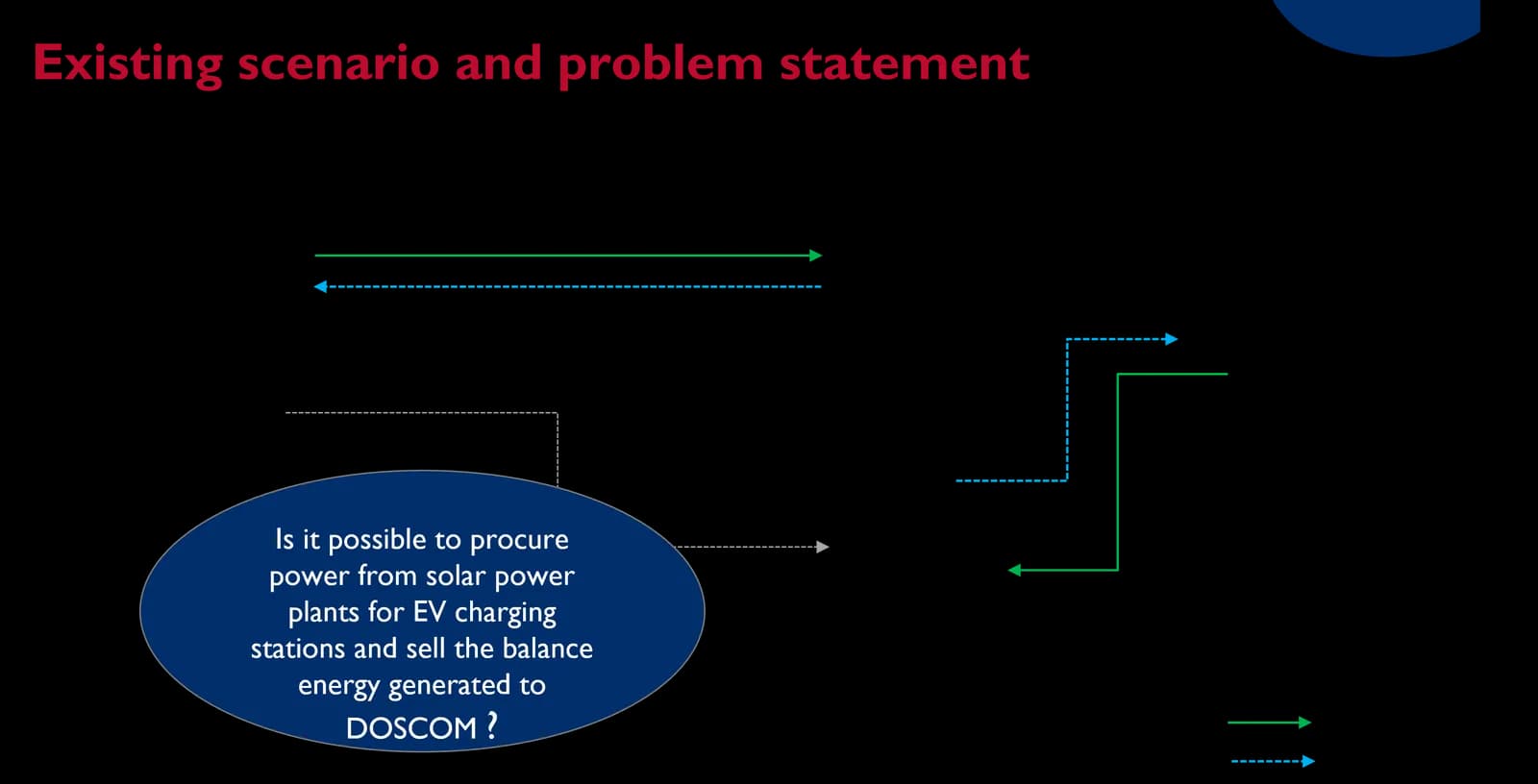
RE Power you will need to procure cheap RE power for solar power plants for EV charging stations and sell the balance energy generated to DISCOM.
The current tariff for consumers to charge EVs ( even if you are a IPPs ) charging stations is very high (INR 14/kWh + additional service charges). This will leading to reduced utilization of the EV charging stations by the users. To become a market leader and beat the above CPOs , you must aims to enhance the consumer footfall at the stations by lowering the charging costs and making it more affordable
Step 1 : Contract with mall / metro / hospital / school
· This contract is for the development of EV charging stations at consumer mall / metro / hospital / school
· The tenure of the contract is 10 years
**Step 2 : Contract with IPP and DISCOM
**
· This contract is for the sale of solar power from IPP's solar plants (aggregate capacity) in state to state DISCOM
· The tariff for electricity is INR 3/-6 kWh for 25 years
Step 3 : Arrive at charging cost by policies
Category* | Year | Fixed/ Demand Charge (Rs/kVA/ month) | Energy Charge (Rs/kWh) or (Rs/kVAh) | Wheeling charge (Rs/kWh) or (Rs/kVAh) |
LT VIII – Electric Vehicle Charging Station | FY 2023-24 | 75.00 | 6.08 | 1.17 |
FY 2024-25 | 80.00 | 6.58 | 1.17 | |
EHV HT IX: HT – Electric Vehicle Charging Station | FY 2023-24 | 75.00 | 6.90 | - |
FY 2024-25 | 80.00 | 7.40 | - | |
HT IX: HT – Electric Vehicle Charging Station | FY 2023-24 | 75.00 | 6.90 | 0.60 |
FY 2024-25 | 80.00 | 7.40 | 0.60 |
⚙️ Get EV selling ready from experts
📩 Contact [email protected]
🔧 RE purchase. Contracting. Hardware.